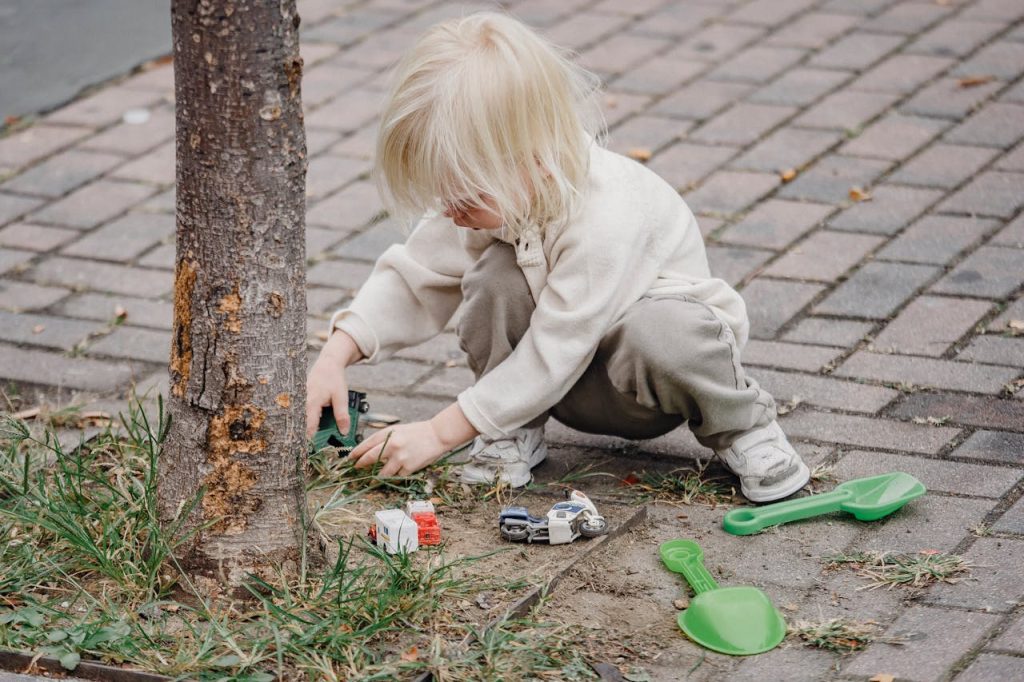
Play is more than just a source of entertainment—it’s a fundamental part of how children learn, develop critical thinking skills, and make sense of the world around them. Research in child psychology and education consistently highlights the crucial role of play in cognitive development, particularly in problem-solving, memory, creativity, and logical reasoning.
At RePlay Lab, we focus on ensuring that high-quality educational toys remain accessible, supporting children’s cognitive growth while promoting sustainability. In this article, we explore how play enhances brain development, the best types of toys for fostering cognitive skills, and how refurbished educational toys contribute to both learning and sustainability.
1. How Play Enhances Cognitive Development
A. Strengthening Memory and Learning Skills
When children engage in structured and unstructured play, they strengthen their ability to retain and apply information.
- Repetitive play (e.g., puzzles, matching games, and sequencing activities) enhances memory recall.
- Role-playing and storytelling help with language development and information retention.
- Trial-and-error problem-solving in building or logic games reinforces perseverance and adaptability.
B. Developing Problem-Solving and Critical Thinking
Play encourages children to engage in logical reasoning and find creative solutions to challenges.
- Building sets and construction toys teach spatial awareness, planning, and structural integrity.
- STEM-based educational toys introduce cause-and-effect thinking, an essential skill in science and engineering.
- Board games and strategy-based play help children anticipate consequences and develop decision-making abilities.
C. Encouraging Creativity and Flexible Thinking
Play fosters imagination and out-of-the-box thinking, which are crucial for cognitive flexibility.
- Open-ended toys, such as LEGO or magnetic tiles, allow kids to experiment with different structures and designs.
- Art-based toys, such as colouring kits or clay modelling, nurture creative problem-solving.
- Interactive storytelling and pretend play enhance verbal expression and creative reasoning.
2. Best Types of Toys for Cognitive Development
A. STEM and Logic-Based Toys
Educational toys that encourage science, technology, engineering, and mathematics (STEM) learning:
- Coding robots introduce problem-solving and logical sequencing.
- Circuit kits and electronic learning toys teach cause and effect, fostering an early interest in technology.
- Building sets and modular design kits support engineering and spatial reasoning.
B. Classic Cognitive Development Toys
Traditional, screen-free toys remain some of the most effective tools for early learning:
- Puzzles and shape sorters develop hand-eye coordination and problem-solving skills.
- Memory games and sequencing cards help strengthen pattern recognition.
- Marble runs and physics-based playsets encourage critical thinking about movement, gravity, and balance.
C. Interactive and Role-Playing Toys
Pretend play enhances language skills, social awareness, and emotional intelligence:
- Dress-up sets and dollhouses encourage storytelling and role-playing.
- Cash registers and play kitchens support basic maths and problem-solving skills.
- Toy toolkits and DIY kits teach planning and sequencing.
3. The Role of Refurbished Toys in Cognitive Development
At RePlay Lab, we believe that educational toys don’t lose their cognitive value just because they’ve been previously used. By refurbishing high-quality toys, we:
- Extend their educational benefits to more children and schools.
- Reduce environmental impact by keeping valuable learning resources in circulation.
- Ensure affordability, making STEM and cognitive-development toys more accessible.
Sustainability and cognitive development go hand in hand—by choosing refurbished toys, parents and educators support both childhood learning and environmental responsibility.
4. How Parents and Educators Can Support Cognitive Development Through Play
A. Encourage Open-Ended Play
- Provide children with toys that allow for creative exploration rather than rigid, one-solution tasks.
- Allow children to experiment, make mistakes, and try new solutions without pressure.
B. Balance Guided and Independent Play
- Some activities require adult guidance (e.g., learning a new puzzle), while others thrive on independent exploration.
- Let children take the lead in their playtime, encouraging confidence and self-directed learning.
C. Rotate Toys to Encourage Engagement
- Introducing different toys at different times prevents boredom and keeps cognitive challenges fresh.
- Combining different play styles (e.g., logic games with pretend play) supports well-rounded development.
Conclusion
Play is one of the most powerful ways children develop cognitive skills, from problem-solving and creativity to memory and logical reasoning. By choosing educational, interactive, and STEM-based toys, parents and educators can help children strengthen their mental agility while having fun.
At RePlay Lab, we’re committed to keeping high-quality educational toys in circulation, ensuring that children continue to benefit from cognitive development opportunities while reducing environmental waste. Through responsible, sustainable play, we can shape bright, innovative minds for the future.
For more insights into child development, educational play, and sustainability, continue to follow our blog at RePlay Lab.